Some
times brilliant, sometimes tragically ordinary observations on life from a pistol-packing neo-con

Friday, January 08, 2010

WHY THE FIXATION WITH AIRPLANES?

This crotch bomber episode makes me wonder why Al Qaeda has such a fixation on airplanes. Okay, to give them their due, they did pull off quite a coup on 9/11 using planes as guided missiles. Sure got everybody's attention. But if they want to tie us in knots there are surely better, easier ways to do it.

The Mumbai attacks, for instance. Talk about terrorizing a population. Most people don't fly or don't fly often. Every person lives a life that includes going to work, driving, walking, eating out--all the trivialities of our daily existence. How terrorizing is it when you feel you can't do any of those things?

I understand Al Qaeda's desire to get the biggest bang for their buck, no pun intended, but I wonder if they're really more interested in PR and their image in the jihadi world than they are in truly terrorizing this country.

If I were in charge of Al Qaeda, here's what I'd be doing: attacking soft targets like malls, schools, factories, etc. You know they have sleeper cells here, as do Hamas and Hizballah. I'd activate my sleepers and send them out in small teams of one or two men to attack soft targets with automatic weapons, grenades and C-4. And I'd do it serially rather than simultaneously.

On Monday I'd hit a mall in Bangor, Maine; Tuesday a school in Salem, Oregon, etc. I'd keep the attacks up for at least a week. Then I'd sit back and laugh at the panic.

Can you imagine what this country would be like after a week of attacks on civilian targets from one end of the country to the other? I'm not sure chaos would be too strong a word.

In terms of terrorizing a population it would be an exquisite tactic. But AQ won't do it because it doesn't make a big enough splash for them in the jihadi world. We're probably lucky because they're so full of themselves and so eager to burnish their image in the wacko world.

Thursday, January 07, 2010

OSAGE ORANGES & RECURRING NIGHTMARES

I was surprised to see a few Osage oranges still clinging to the trees I pass most days on my dog walk. They're all shriveled up and brown now, but they haven't fallen to the ground.

I wonder if that means they're duds, because there's no way they can scatter their seeds hanging on the tree. Or maybe it's just one of those things that happen for no apparent reason. Most of the pods drop, but some don't--or at least not until they're all dried up and useless.

I love Osage orange trees and wish I had a windbreak of them. They're exceedingly sturdy trees that can survive just about any conditions. In the old, old days--before the invention of barbed wire--farmers used to plant them for fencerows because their short, stout thorns kept cattle and horses where they were supposed to be. "Horse high, bull strong and hog tight" is how they were described. But they had to be aggressively pruned to keep the growth bushy and the thorns down where they'd do some good. Otherwise they'd grow just like any other trees and the thorns would soon be up above the heads of the animals they were supposed to deter.

Plains Indians supposedly loved them because their wood made great bows, better even than yew trees. They allegedly ate the fruit, but that's highly unlikely. The seeds are edible, but they're in the every core of the oranges and difficult to get at.

Old people say they repel spiders, but the young 'uns laugh at that. But like a lot of folk wisdom, there is a kernel of truth in it. The Osage oranges emit a chemical that spiders find disagreeable. There's at least one company that makes a spider repellant spray that contains the same chemical. It's not toxic to us or the spiders.

A couple of years ago I decided to I wanted some for the house, garage and barn, so on one of our walks I strapped on my big external frame pack and broke forty or fifty yards of trail up to where the trees are. I jammed as many as I could into the pack--forget the final count, but I think it was somewhere between thirty and forty--and headed back to the truck.

Damn things were a lot heavier than I thought they'd be and I slipped just as I was getting ready to jump a ditch and fell down. I was like Randy in A Christmas Story when he fell in the snow--I couldn't get up. Somehow I managed to get the pack off, get to my knees, then get the pack back on.

That was the longest half mile back to the truck. I was wet, muddy and sore, but I had my spider repellers.

When I walk by in the fall and see the trees covered in bright-lime balls I get the urge to take some home, but then I remember the fiasco with the backpack and just walk on by.

###

Woke up this morning out of a nightmare--the TV news producer's nightmare all over again. This time I was in Kentucky, working for a woman who looked amazingly like Jane Horrocks, the English actress who starred in the BBC series The Amazing Mrs. Pritchard, which I had just finished watching last week.

As in every one of my other TV news producer nightmares, I was told at the last minute that I had to produce a newscast on a day when I was not supposed to be producing. Let me tell you, producing a TV news show is nightmare enough, but getting thrown into it unsuspecting is way beyond the pale.

I haven't produced a newscast in more than twenty years, but I swear I have one of these nightmares at least a couple times a month. Other people have nightmares about tests they forgot to study for--I haven't had one of those since...well, since before I started producing newscasts in the early 80s.

###

It's snowing again--hard. It's a storm this time and it's gonna dump 3-6 inches on us between now and Friday morning. Then the lake-effect snow machine is gonna fire up again and we could get another  6 inches. This isn't a nightmare, it's a daily assault.

Sucks to be us.

Tuesday, January 05, 2010

FORGET WHAT I SAID BEFORE

I am going to complain about this lake-effect snow business. I've had enough. No sooner do I get it cleaned off the driveway than it's dumped all over it again.

The forecast has snow in it for at least the next seven days. Yeah, that's a week. And it's snowed every day since New Year's day.

Okay, there's some places in the snowbelt that already have 3 feet on the ground, but that's their bad luck. It's the price they pay for living on the east side.

I say enough already.

ODDS 'N ENDS AND ODD THOUGHTS

The Lake Erie snow machine keeps pumping in the white stuff. You can barely tell I cleared the driveway yesterday. But I've vowed not to complain. I heard this morning they have 29 inches on the ground in Chagrin Falls, so the 6 or 8 inches we have is nothing to complain about. Could be a lot worse. God only knows what it's like in Chardon or Ashtabula.

I've just started reading Edwin Way Teale's third book on the seasons, Autumn Across America, and once again I am amazed at how astute the guy was. His observations aren't necessarily huge startling discoveries, but they are wonderful little insights into how the world works and sometimes why.

In one of the early chapters Teale puts on swim fins and mask and takes us under the shallow waters of Shinnecock Bay on Long Island to look at eelgrass. Sort of an odd choice of habitat to observe in a book about fall, but there's a method to his seeming madness, for he's interested not just in slimy seaweed, but the web of life that's connected to this seemingly unimportant plant.

Teale tells how a mysterious catastrophe brought death to the eelgrass on both sides of the Atlantic and altered life both in the water and on the shore.

In late 1930 eelgrass began dying off along the Atlantic coast. By the summer of 1931 it was dying all the way from North Carolina to Cape Cod. The following year the mysterious epidemic spread north to Canada and also devastated eelgrass beds in England, Holland and France. By 1933 less than one percent of the eelgrass along the east coast, from Labrador to Beaufort, North Carolina, was still alive.

The first casualty was the brant, whose diet once consisted almost exclusively of eelgrass. When 90% of their food disappeared, so nearly did the brant. Their numbers shrank so alarmingly the government declared a year-round closed season along the eastern seaboard.

Next came the scallops, which live largely in eelgrass beds. When they disappeared, so did a lot of the shellfish industry. Then came companies that used eelgrass for soundproofing and furniture stuffing: they went out of business because their raw material was no longer available.

The list goes on and on, but the point is the same: a seemingly mundane plant that most of us at the beach would see as more bane than boon was a key link in the chain of life. When it died off, the repercussions were felt far from the shallow bays of our eastern seaboard.

But not all of Teale's observations are so earth-shattering. The four pages he devotes to the simple scallop are just fun. Did you know scallops have eyes? Came as a shock to me, too. Do you know they can swim through the water backwards and forwards like a jet propelled flying saucer? I assumed they sat on the bottom like other clams, relatively inert. Hardly. They've even been observed migrating in great hordes when they're young.

I don't know about you, but I love picking up these little nuggets of knowledge. Do they change my life? Probably not, but I think if you have any curiosity about the world around you it's just fun to know these sorts of things.


Monday, January 04, 2010

LIVING WITH A GREAT LAKE

People who live in other parts of the country--hell, people who live in other parts of Ohio--have no notion of what our Great Lakes are really about. They have no sense of their size, scale and influence.

When you tell people in central Pennsylvania you live about 15 miles from the shore of Lake Erie, they say, oh, that's nice, and move on to other things. They hear lake and they think it's something just a bit bigger than a pond, which is, after all, the definition of a lake.

Their eyes get big when you tell them you can't see land from the middle of Lake Erie, that the Great Lakes are 20% of the world's fresh surface water, 90% of the country's. The coup de grace is when you tell 'em if we pulled the plug on the Great Lakes, the entire Lower 48 would be under nearly 10 feet of water. That kinda gets and keeps their attention.

English is the most descriptive and precise language in the world, yet it does not have a word that accurately describes the Great Lakes.

Ocean would not be appropriate because by definition it is both vast and salt water. The vast pretty much applies, but not the salt part. We do have tides--seiche--like the oceans, but they're strictly wind-driven. They can be impressive on Lake Erie under the right conditions, but we don't have any Bay of Fundy sort of rise and fall.

I'm thinking about the Great Lakes today because we're having another bout of lake-effect snow in Lorain County. It's not unheard of here, but it's far more rare than on the east side of Cleveland in Ohio's snowbelt, where lake-effect pushes the yearly snowfall total upwards of the 120" mark (for those of you at home, that's 10 feet).

Anytime the wind is out of the north or slightly NNW, we get hit. The snowbelt gets slammed from nearly any compass point from WNW to NNE. Technically, we're in the secondary snowbelt.
So that part of living next to Lake Erie kinda sucks, but there are good points. The growing season is longer here than most areas at this latitude, thanks to the lake. Drive around the southern shore of Lake Erie and you'll see numerous vineyards and fruit orchards, even a dozen miles inland.

We also get our drinking water from Lake Erie, so no drought of any length has any impact on our water supply. That's one of the reasons why these Federal laws requiring low-flow showerheads and crappy little toilets make no rational sense. Beyond the fact that the Federal government has no business meddling in these areas, there's no way we can ever run out of fresh water here so why do we have to live under the same rules as people in Arizona? If ever there were an issue that should be solely the purview of state and local government, this is one of them.

The mere existence of Lake Erie also provides us with terrific birdwatching opportunities a couple times a year. During the spring and autumn migrations, millions of birds have to cross the lake. Where most of them cross, the shortest hop is 35 miles of open water. So they pile up along the Ohio shoreline in the spring to feed and rest before making the hop over the lake.

The best place to see up to 300 species of birds is the Magee Marsh Wildlife Refuge, between Toledo and Port Clinton. The state built a boardwalk through the marsh there and if you hit it at the right time, the warblers and other birds are literally dripping from the trees. Many of them are surprisingly tame and you'll probably never get a better up close and personal look at them.

I guess you have to take the bad with the good, but when I was out clearing 5 inches of bad off the driveway today, I wasn't nearly so willing. Now that I've thought about it in the warmth of my home, I guess I can live with it.

One footnote, the Cooper's hawk was back again today, this time sitting big and bold in the oak tree above the suet feeders. Managed to get the camera on him this time, but couldn't get proper focus. I hate all this modern technology. Why do I need the camera to focus for me when I'm perfectly capable of doing it myself? I haven't even bothered to pop the memory card to check it, because I know the shots will be out of focus. I need to get the manual out again, I suppose. I never had to use a manual the size of the OED to get good pix with my 35mm SLRs.

Saturday, January 02, 2010

EVERYBODY'S GOTTA EAT

The Cooper's hawk was here this morning, sitting in the maple tree above the feeders. He comes in close every few days it seems, hungrily eyeing the little birds we attract with seeds and suet.

We admire raptors from afar but are repelled when we see them kill other creatures and eat them. But like it or not, that's the order of things and everybody's gotta eat.

It's hardly the same as somebody's stupid house cat that kills songbirds just for the hell of it. The cat is well-fed in the house and has no need to kill, because most of the time it won't eat its prey anyway. A barn cat is a different story. It pretty much has to kill its dinner or starve.

I have to laugh at all the granola eaters who think nature is some benign, benevolent Eden where all creatures great and small smile at each other and get along. Nature is tooth, claw and fang, ladies and gentlemen. Eat or be eaten. Predator or prey. What the hell do you think food chains are all about?

I'm not sure which birds Mr. Cooper's hawk prefers, but I'm okay with whatever he needs to survive. I just hope he's partial to doves. We have more than enough of them around and they're some of the dumbest birds I've ever seen.

Monday, December 28, 2009

PHEASANT ALERT

When you live in the country you're liable to see just about any wild critter on your property. We've had deer, possums, rabbits, field mice, hawks and a grebe. That's in addition to somewhere between twenty and thirty species of birds.

But one thing you seldom see in the Ohio countryside anymore is a pheasant. Northern Ohio used to have great pheasant hunting with a large wild population of birds. That all changed when the farmers tore out hedgerows and plowed up every acre of land they could possibly plant. When Earl Butz told them to plant fencerow to fencerow, that's just what they did.

That pretty much signed the death warrant for a wild pheasant population. You still see the occasional bird, but most of them are pen-raised birds the state has put out for hunters or escapees from a pheasant farm.

Today my son yelled out he saw a pheasant in the weeds between our property and the next one to the west. I looked and looked and saw nothing. Then I spotted a cock bird scooting out of the weed patch into the bamboo, where he disappeared.

We never saw him again, so I'm guessing he moved on, but you never know. There are plenty of good places for him to hide between the bamboo and the ditch. Big pine trees and a lot of weed that I stopped mowing last year. Be kinda cool if he came into the bird feeders. Probably never happen, but you never know.

Hope he was a wild bird and not an escapee. In either case, it was good to see a pheasant somewhere other than in the bead of my shotgun.

Wednesday, December 23, 2009

TECHBOY? NOT SO MUCH, REALLY

I admit to being a bit of a gadget geek. I like technology and I like the latest and greatest gear. Hell, I had a computer in 1982. What a piece of crap that thing was: Timex Sinclair 1000 with a whopping 4K of memory. Of course I had the optional memory expander that took it to a screaming 16K.

No monitor, of course, you hooked it up to a TV and it output a B&W picture. No hard drive, either. You'd write these little Basic programs and accidentally jiggle the power cord and lose all your work. You could save your programs onto a cassette tape using your portable cassette player. Then you had to load them into the computer whenever you wanted to use them. It had a chiclet keyboard that was a nightmare to use. All in all it was a lame excuse for a computer.

I think my second computer was an Amiga 500, which for its time was an amazing little piece of technology. It was the first personal computer capable of pre-emptive multi-tasking. In the beginning it also lacked a hard drive, but it did have a great display. It was a pioneering computer in terms of graphics. It had a set of graphics chips that handled all the display stuff and left the CPU to do the number crunching it was designed to do.

I've had all the gizmos and gadgets over the years. But there were some things I skipped or ignored. I never had one of those early cell phones that were the size and weight of a brick. First cell I had was a little Motorola, I think. I've had so many since about 1995 it's hard to remember.

It's funny, though, how I can't seem to get used to using some aspects of technology. Every day when I get dressed, two things are part of my ensemble: a shoulder holster holding my Glock 31 and my iPhone. That iPhone is always in my pocket from the beginning of the day until the end. But I can't tell you how many times I have not thought to pull it out of my pocket and use the camera to capture something cool I've seen.

Granted, the camera on the iPhone sucks. It doesn't have the resolution of a lot of cell cameras and it won't zoom (until tonight when I bought Camera Genius from the AppStore). Doesn't have a flash, either, but that's sort of incidental. Hi-res and zoom are much more important.

Last week on two occasions I saw a barred owl that was close enough to capture on video. Did I whip out my phone and snap it? Nope, sure didn't. Frankly, I didn't even think about trying.

So what does that say about my tech prowess? I'm not sure. Having the technology but not using it could be a sign of a crypto-Luddite outlook. Well, maybe not. Could just mean my brain hasn't been trained to think that way yet. The kids take pictures of everything--including themselves with little or nothing on--and send them to everybody. I just don't think of my phone as a camera. Mostly I just use it as a phone, even though I have about 30 apps on it, most of which I've never used.

Maybe I'm just a tech-savvy Luddite.

Saturday, December 19, 2009

NATURE AND CHANGE

Great column in today's Wall Street Journal by a retired biology prof about how the entire global warming construct is fundamentally flawed because it assumes nature is in a steady state, almost static, when in fact it is constantly changing in ways we cannot foresee.


He tells the story of canoeing around Isle Royale one evening and watching a bull moose display what could only be called puzzling, bizarre behavior. It took him years to realize the moose was an apt metaphor for the true character of nature:


Most of the major forecasting tools used in global-warming research, including the global climate models (known as general circulation models of the atmosphere) and those used to forecast possible ecological effects of global warming, paint a picture of nature more like a Hudson River School still-life than like the moose that kicked at the shore. These forecasting methods assume that nature undisturbed by people is in a steady state, that there is a balance of nature, and that warnings the climate is at a tipping point mean that the system is about to lose its balance.

In fact, however, nature has never been constant. It is always changing, and life on Earth has evolved and adapted to those changes. Indeed many species, if not most, require change to persist. So there is something fundamentally wrong in most approaches to forecasting what might happen if the climate warms. The paradigm is wrong and has to change. But such fundamental change in human ideas never comes easily, and it is often resisted by those whose careers have been based on the old way of thinking. In addition, the general circulation models are such complex computer programs, and have been developed over so many years, that a fundamental change in the entire way of thinking about climate dynamics and its ecological implications is all the more difficult.


Anyone who has spent much time in the woods and fields would know he's right. The only thing constant about nature is change. Yes, there are patterns you can discern, but just when you think you have it all figured out, nature throws you a curve you never saw coming.
Here's one I saw myself and actually managed to capture:


Yes, that is in fact a groundhog in a tree. Groundhogs aren't supposed to climb trees, but don't tell them that. This one climbed a tree because my dog chased it and it couldn't make it back to one of its holes. It probably wasn't in any danger from my Lab--she's more into eating baby rabbits and mice than tackling something this large--but the groundhog didn't know that. So even though he's supposed to be a completely terrestrial creature, this groundhog got airborne because he had to.
I've never read about tree-climbing groundhogs before, but people who hunt or otherwise spend a lot of time in the woods will tell you it's not a freak accident. Animals--like nature in general--adapt to changing circumstances. Isn't that what evolution is all about? Adaptation?
But you don't really need groundhogs in trees to know there's much about nature that's beyond our ken. Just study the tiny hummingbird if you want to be humbled.


Thursday, December 17, 2009

MORE BACKYARD BIRD NEWS

The Juncos are back. Saw a couple of them hopping around in the Rose of Sharon bushes this afternoon. Also saw a Tufted Titmouse. Eats just like the nuthatches and Chickadees: grabs a sunflower seed and whacks it against a tree branch to help open it.


There was also a flock of Starlings here this morning, but not the huge hoard you usually get. They were hanging off the suet feeders and hogging the food, as they always do. I let 'em go for a while, then pounded on the glass to scare 'em away. I don't begrudge anyone a meal, but there are limits when it comes to Starlings.


The Cooper's Hawk was hanging around late in the afternoon yesterday. He was in the maple tree where I have my trail cam hanging. Ran to get the camera hoping I could haul him in with the 300mm tele, but when I raised the camera he took off like a shot. I'm surprised, because he seems to have become somewhat tame--as tame as any wild hawk can be. I've caught him sitting on the deck railing any number of times.


It would be very cool to have a color video cam trained on the feeders to capture all the comings and goings during the day. There may be all sorts of interesting bird I never get to see because they come when I'm not here or not looking. Something like a security camera attached to a hard drive or an old VCR. Would be a pricey proposition, though.


It's supposed to warm up tomorrow, so I may get out the hedge trimmers and lop off about three feet of the Rose of Sharon bushes. Even without leaves they hinder my view of the feeders. Should have done it in October when it was still warm, but the bushes held their leaves well into November and even re-flowered. Weird. Must be the work of the Goracle.


Here are some trail cam pix from the end of October I forgot to post. Finally captured something other than a fat black Lab hunting rabbits and mice.


Wednesday, December 16, 2009

WHITE-BREASTED NUTHATCHES

Last few days there have been some White-breasted Nuthatches on the feeders. They seem to come and go--sometimes I won't see them for days or weeks.

I like having them around because they're fun to watch. Nuthatches seldom sit still, flitting from one place to another they're a perpetual motion machine. They're on the feeder one second, grabbing a seed--often upside down. Then they flit to the maple tree to eat the seed they've just liberated. But they don't often go right back to the feeder. Usually they'll run around on the tree first, often upside down there, too.

Chickadees are still my favorites, both for their antics and for their tameness. When I fill feeders they won't fly away like other birds. They'll perch on a branch four or five feet above my head and chatter at me to hurry up and put the new food in so they can get busy on it. I'm sure I could train them to eat out of my hand, but I don't much feel like standing stock-still in the cold waiting for them to get used to me.

It would be kinda cool to train them, though. It freaks people out when they see Chickadees eating from someone's hand. Feels really weird, too, when they hop around on your palm and dig in with their tiny claws. If you didn't feel that you'd never know they were there because they're so light you cannot feel any weight in your hand. They literally are just a tiny bundle of fluff.

Tuesday, December 15, 2009

EDWIN WAY TEALE


If I mentioned the name Henry David Thoreau, you'd probably know who he was, or at least you'd think of Walden almost immediately. If I said John Muir, you'd probably come up with Yosemite and the Sierra Club. You might even know Aldo Leopold and A Sand County Almanac. But I'd almost be willing to bet the ranch you've never heard of Edwin Way Teale. And that's a shame.


Teale was a naturalist, photographer and writer--Pulitzer prize winner--who published more than thirty books, starting in 1930 and ending with his death in 1980. The topics of his books were very catholic, although they were all about the natural world in one way or another.

His most famous books were a quartet on the seasons of North America: North with the Spring (1951), Journey Into Summer (1960), Autumn Across America (1956), and Wandering Through Winter (1965), which won the Pulitzer for general non-fiction in 1966.

I bought all four earlier this year--used, to be sure, because none is still in print, more's the pity. I've read the Spring volume and I'm now working on Summer. They're not quick reads because the writing is dense and often a bit turgid, although marvelously descriptive.

Teale and his wife hopped in their car and followed the seasons across the continent, zigging and zagging, logging tens of thousand of miles--and God knows how many notebooks--in the process. It's fortunate Teale started when he did--1947--because there were no interstate highways and very little development outside the major urban centers. Mostly he stuck to those roads Bill Least Heat Moon calls Blue Highways, roads off the beaten path that sometimes lead to nowhere in particular, which is why some of us like to take them.

These are books filled with the wonders of the natural world and the wonder of a human being who is thrilled to be seeing it all. No environmentalist polemics here, just a naturalist's appreciation of the teeming life around him and the occasional gentle poke at the folks who don't appreciate the wonder of it all.

If you have any interest in the natural world I'd commend them to you. Buy all four and watch all four seasons of the year unfold across the country and the page. If you're a wacko greenie you'll probably find them entirely too sublime. But if you're a conservationist, as I am, you'll find them to be just about perfect.

(Try alibris.com. You'll find them there for well under $10 each.)

Monday, December 14, 2009

NO MORE COFFEE SNOBBERY

If I had told you ten years ago that Americans would one day pay $4-5 for a cup of coffee you would have called me crazy. A shot of single-malt Scotch, maybe, but not a cup of coffee.

Well, the guy who started Starbucks obviously thought there was a market for snob coffee and he made millions serving it. Everybody just had to have their mocha choca soy non-fat lattes with sprinkles.

I'll let you in on a little secret. I've been grinding beans for my coffee for maybe 20 years. I've tried all the fancy coffees from all over the world, but frankly, I keep coming back to Columbian beans--decaf for the last 15 years or so.

And yes, I do have an Italian automatic espresso maker. It can do latte or cappuccino, but mostly the wand just collects dust. I use it to make regular coffee every morning. I guess technically it's espresso, but I make big cups of it, not those tiny little things you drink in Italian restaurants.

Us coffee snobs would never think to drink something like Maxwell House. And instant? Forget it. Only old people and rural rubes would drink instant.

But you know something, I'm drinking it from time to time these days. I bought an electric kettle--as the Brits call them--that can heat water in about two minutes and I pour it over a couple big spoons of freeze-dried instant. And you know what? It tastes okay.

I think the dirty little secret is, coffee is pretty much coffee. Yeah, you can taste the difference between Columbian and Sumatra Mandheling, but it's still coffee and it still tastes pretty much the same if you dump a bunch of liquid coffee creamer in it.

This holds true of many things in life. A Timex generally keeps time just as well as a Rolex. But the former has no cache to it while the latter screams "I have more money than I know what to do with."

Of course it doesn't hold true of all consumer goods. No one can make the case that a Chevy Aveo drives as well as a BMW. And even a novice can tell the difference between a cheap blended Scotch and an aged single-malt.

But mostly it's all about snobbery, trying to make yourself feel superior to your friends and neighbors. Not keeping up with the Joneses, but leaving the Joneses in your dust. And it's just downright silly.

The message seems to be sinking in with a lot of people--even before this nasty recession started. Starbucks is closing stores, not opening new ones, and their financials ain't good.

So do yourself a favor and just say no to coffee snobbery. It'll make you a better person and put more money in your pocket.

Friday, December 11, 2009

STALACTITES AND COFFEE CLUBS

The sun is out and it's 24º, but it somehow feels colder than yesterday. Wind seems to have more bite.

You know it's cold when the dog has stalactites of frozen slobber hanging from her mouth. Doesn't bother her in the least, but it's a good indicator of windchill.

Lousy day today in the woods. Too windy, too noisy. Had a couple of good squirrel chases, but that was about it for fauna today.

One thing did happen while we were gone. The trash guys dropped off an olive drab cart that we're supposed to use now for recyclables. Yes, Virginia, Camden Township is entering the modern age: we now have curbside recycling.

It'll be convenient, but in some ways it really sucks, because it's going to mean the end of our twice-monthly sessions at the township recycling center.

It's not exactly a recycling center per se. It used to be part of the old township school that was rehabbed into an all-purpose building mostly used for 4-H events, birthday parties and wedding showers. But they also used a recycling grant to buy an old straight truck that they back up to a freight door they installed. Inside the truck are big plastic bins where you drop off your glass, cans and plastic (#1 & #2 only, mind you). When the bins get full, Jim, the township road man, drives over to the landfill/recycling center and they empty everything out so we can fill it up again. It's a real low-rent, low-tech operation that suits us just fine.

Every second and fourth Saturday we go there to drop off our recyclables, and some of us old guys sit around telling lies, drinking coffee and, yes, I'll admit it, occasionally ripping off a good fart when there aren't any women around. It's the only place we have to gather around here.

We used to meet every day at Kipton city hall, but the new mayor and his council acolytes decided they didn't like that, so they kicked us out. Excuse was something about cost of heat and lights, but everybody knows that was a lie, because we didn't turn the heat up and we only turned on a couple of fluorescents and sometimes we sat in the semi-dark. No, they kicked us out because they didn't like the idea of us sitting in their village hall making fun of them. We definitely were guilty of that crime, but mostly we solved all the world's problems every day. We even paid for our own coffee. But they gave us the boot after Al, who was the town clerk, gave up his office.

Al started the coffee club, you see. He'd get there before 9 every morning and put on a pot of coffee and when it was ready, he'd tape a sign in the window that read "Coffee's On." The village hall used to be a little bank and it still has a drive-up window on one side and that's where he'd tape his sign.

They say all good things must end and to our chagrin, that good thing ended in '07. So since then the only opportunity we've had for socializing was the twice-monthly recycling Saturdays. Now even that is giving way to progress. I missed the recycling day after Thanksgiving because we were out of town, so I don't know when the new regime starts. I'm guessing it will be in January. Tomorrow is supposed to be a recycle Saturday so I suppose I'll get the poop then.

The only guy who will be happy with the new arrangement will be Jim. He really hates driving that old piece of shit truck, even though it's only like nine miles each way. Now I guess he won't be bothered with that chore anymore.

Thursday, December 10, 2009

IT'S NOT THAT I HATE COLD WEATHER...

...I just don't like it very much.

Actually, as long as it doesn't snow and make the roads a mess I don't mind winter too much. I like it when the leaves are off the trees and you can really see things in the woods. Birds are tough to spot in the summer because when they're in trees they're almost always hidden much of the time.

Sounds seem to carry better in winter, too. If the wind is calm you can hear animals a long way off. The other day I heard a Pileated woodpecker from at least and eighth of a mile, maybe more. Thwack, thwack, thwack as he slowly wacked away at a tree trunk. Today I saw two Pileateds flying and moving around in the trees. No leave, no problem.

When it gets too cold, though, you have to cover up all your exposed skin and then you feel like a mummy. Today was one of those days: 15º with a windchill of -2º. I took a facemask hat along, but decided not to use it because the woods would shield us from the wind, at least partially. So I pulled on a knit hat over my ball cap to cover my ears.

But I don't feel comfortable with my ears covered because it really impedes hearing and you often pick up animals with your ears rather than your eyes. And if you pull the hat down far enough it cuts your vision as well. How often have you picked up movement in your peripheral vision? Lots of times, I'd guess. I know I have.

So for whatever reason we didn't see too much wildlife today. Not a squirrel, nor a deer. Lots of woodpeckers moving around again, though. In addition to the Pileated woodpeckers we saw Downy woodpeckers and a Red-bellied. Chickadees and Nuthatches, too.

Dogs seem to pick up more scents in the winter. Maybe because there's no background smell from flowers and plants. Don't know why or how, just seems to be.

Wednesday, December 09, 2009

DOES FATHER KNOW BEST?

I recently bought the first season of Father Knows Best. I remember that show like it was yesterday. Funny thing is, the show started its run in 1954, when I was one year old. I'm pretty sure we didn't have a TV in 1954, and if we did, I'm pretty sure I wasn't watching it. Even if by some miracle I was watching it, what are the odds I'd remember 55 years later something I'd seen when I was one?

Now, the show ran through the '59-60 season, so I must be remembering the later episodes. By then Betty was pretty grown up and kinda hot--at least to a seven year old--and Bud was even dopier than he was in 1954. Must be the shows I saw when I was five or six or seven that I'm remembering.

It's funny to watch those first season episodes because Robert Young looks way too old to be the dad of that family. He looks nearly as old as Marcus Welby, MD, who was old. Jane Wyatt doesn't look like a spring chicken, either.

These '50s TV shows are a great retro microscope on American culture back then. Dad wore his suit at the dinner table, mom wore a cocktail dress under her apron and the kids wiped their mouths with cloth napkins before asking to be excused from the table. Mom and dad slept in separate twin beds that were covered with those nubby bedspreads. Mom stayed home and cleaned the house and cooked while dad went off to an office we never got to see. Oh, and mom wore FMPs when she did the vacuuming.

We do know what Jim Anderson did for a living, though: he sold insurance. I like that little touch. I'm still wondering what Ward Cleaver did. We got to see him at the office a few times, but it was never clear exactly what he did. Sales, maybe. But what he might have sold remains a mystery. I guess if it didn't matter to Wally and the Beve it shouldn't matter to us, either. It's just one of those little things that have always bothered me.

BTW, Leave it to Beaver ran from 1957 through the 1963 TV season. TV seasons used to start in October and run through June. Shows used to have 39 episodes each season. Talk about change....

Tuesday, December 08, 2009

WILDLIFE AND A WILD DOG

I haven't taken the dog to the Vermilion River Metropark since it was hot out. We used to go most days during the summer so she could swim in the river. Labs love water and this one is crazy about it. Black Labs don't much care for summer sunshine--they heat up real quickly.

But I got bored with taking her to the bike trail in Kipton, so yesterday and today we went to the park and walked the Bacon Woods Trail, which winds through the woods for about a mile.

Yesterday we saw a Barred Owl, tons of fox squirrels, two deer and a mess of small woodpeckers. I think it's the first time I've seen a Barred Owl. Wow, it's a big bird. I thought they were just little things, but it's nearly as big as a Great Horned.

It's kinda spooky when they sit there looking at you with that owl face. When I first saw him he was only about 20 feet away in a small tree. He stayed there maybe 30 seconds before flying deeper into the woods and perching higher up in a big tree. Very cool.

There are some very hefty fox squirrels in the park. One of those suckers would almost feed a small family. I don't think I've ever seen fox squirrels that big and fat. The dog sure loves to chase them, but she hasn't quite figured out where they go, although today she did tree one and jump up against the tree and watch it run up the trunk. Then she started yelping a high-pitched yelp I've never heard before. It was pretty funny.

She never did see the two deer yesterday. When I saw them they were already on the move and I didn't see much more than white flags bouncing through the woods. I told her to go, and she did, but she never saw them. She ran around a bit smelling something, but they were long gone.

No owls or deer today, but we did see two Pileated Woodpeckers. They are impressive birds, especially when they attack a tree. You can find them pretty easily when you hear that loud, slow thwack, thwack. The sound carries quite a distance on a clam day. They're also large birds that are easy to spot. The big crest on the back of their heads makes you think of a pterodactyl.

On the way home a Great Blue Heron flew over the truck just as we got to the north end of Kipton.

All in all a pretty good two days. Colder than a bitch, but nice days for walking in the winter woods. I had a good time spotting wildlife and the dog had a good time chasing it.

RESTORING A LITTLE DISCIPLINE

Sherwood Anderson once said the hardest part of writing is putting the seat of the pants in the seat of the chair. Boy, did he get that right.

Once upon a time I wrote a lot of copy every day. Sure, it was only TV news copy, but at least I was writing. Even after I left TV news I still wrote freelance magazine and newspaper pieces for a time.

But for at least the last ten years I have been a complete slug. I have written next to nothing of any length or worth. Hell, I haven't even written anything for this stupid blog since May.

It's time to shake off the sloth and get busy again. I'm going to force myself to blog something daily--or as close to that as seems worthwhile.

It's time to stop being a fat, lazy slob. Writing won't make me lose weight, but it can help me to be less lazy.

Tuesday, May 05, 2009

THE REDBUDS ARE MAGNIFICENT THIS YEAR

Spring really came on in a rush when we had four days in a row of 80º+ temps. There was barely a green haze in the woods and then almost overnight everything was green.

I saw honeysuckles in bloom, which is really unusual for the end of April/beginning of May. The redbuds are magnificent this spring, but other flowering trees like the weeping cherry seem to be sparsely flowered. Our red flowering crab was very good, though. It came on in about two days.

I hate when we have these really hot spells this early. I like things to develop apace, so you can savor each thing as it blossoms. When you have four days of 85-87, it just forces everything out at once and you're overwhelmed by it all.

But we can't change the weather, so what's the point in complaining. It's sure a lot better than a late freeze like we had two years ago that nipped a lot of plants and trees in the bud, so to speak. Did a real number on the peaches that season and they were very scare here locally.

Tuesday, April 21, 2009

DANDELION SEASON

Things are finally starting to green up around here. The willow is leafing out, the lilacs have lots of buds on them, and the grass is greening up and starting to grow quickly--that last isn't necessarily a good thing.

And those little yellow sunspots we call dandelions are popping up all over the yard. Makes a nice contrast with the greening grass.

If you live in the 'burbs you're expected to run right out and kill all the dandelions. Or put crap on that will keep them from coming up at all. But out here in the sticks we're a bit more tolerant of them. They add a bit of color and are far from the worst weeds we have to battle. I've gone through a lot of Roundup trying to keep some of them from taking over everywhere.

Once again I have the urge to plant an acre or so of prairie grasses and wildflowers, but I'd have to kill off all the existing grass--weeds, really--and drill it into the soil. Things would be pretty ugly and muddy for a year or two until the prairie plants got going good.

There's also the issue of a pond, which I want to put in in the worst way. These days with the laws the way they are, the SWCD does the deciding on where you can put it and how it's going to be done. So there's no point wasting time and money starting a little prairie if I'm going to have to rip it out to put in a pond.

Tuesday, April 07, 2009

SECOND DAY OF SNOW--MUST BE BASEBALL SEASON

For two days now we've had lake-effect snow. At times the squalls have been extremely intense, nearly whiteout conditions. The fields are all white--for the moment. Won't last long because it's gonna warm up gradually as the week wears on.

Turned out to be a good day for walking, however, because the snow, wind, and cold kept the bicycle fairies indoors. The dog got to chase a red squirrel--twice. The ditch was nearly overflowing with water from the quarry, so of course the mutt had to get in and splash around.

Had some nice conversations with a couple of Chickadees. They're always fun to fool around with. Then I saw a Tufted Titmouse and figured, why not try conversing with him, also. Well shut my mouth, that bird just went wild. I don't know if he thought I was another male trying to horn in on his territory or if he thought I was a female who sounded damned sweet, but whatever he thought he sure sang like there was no tomorrow. He flew over my head to a tree about 20 feet away and proceeded to sing at the top of his lungs. And he kept on singing even after I stopped and walked away. Interesting.

Saturday, April 04, 2009

TOWHEES, TOWHEES, EVERYWHERE


I meant to write this the other day, but I felt like shit when I got back from my walk, so it never got written until today.

As spring gradually creeps forward we're seeing more neo-tropical migrants starting to arrive to join the brave birds that spend the entire year here. Lots more songs to hear and colors to see.

Eastern Towhees are pretty, gregarious birds that are often heard before they're seen. I saw one the other day that I didn't recognize at first because of the way the light was hitting it and also because I wasn't thinking Towhee. They're usually around in the summer and I've never seen them this early.

At any rate, I saw this bird that looked familiar but out of place, then I heard it sing and I knew immediately what it was. I don't claim to know too many bird songs, but once you've heard a Towhee, you'll never forget that lilting drink-your-tea. Once when I lived in Toledo I was walking in one of their Metroparks when I heard a Towhee very close by. He was in a tree, but not terribly high up and he was singing to beat the band. I decided to try to whistle his song back to him, and we had at least a ten minute conversation before one of us--can't remember which--got bored and moved on.

So once I heard drink-your-tea I pulled out my iPhone and fired up birdJam and began talking back to him. As I walked along, he followed, flitting from one side of the trail to the other. At first I thought there was but one bird, but then I saw three within about 40 feet and heard others a bit farther away. I'm guessing there were at least five Towhees in about a 100 yard patch.

Some birds respond to canned calls, while others don't seem to like them. Cardinals seem to be in the latter category. I've called male Cardinals any number of times and they always seem to fly away rather quickly. Chickadees, on the other hand, will almost always respond. They're curious little birds and have little fear of people and many of us have had them eat out of our hands. I'm convinced if I held my iPhone out flat and stayed perfectly still a Chickadee would eventually land on it to see where that singing was coming from.

Friday, March 20, 2009

IT'S SPRING (SORT OF)

The vernal equinox came and went this morning; now it's official. So of course it's only 36 degrees and the wind makes it feel even colder. Didn't bother the dog--she jumped in the water-filled ditch like she always does. But my ears were damned chilly and my eyes and nose were running to beat the band.

Of course it's been spring here--mostly--for a while. The red-winged blackbirds came back a couple of weeks ago. Everywhere you go in the woods you hear a cacophony of bird song and wherever there's standing water in the woods you hear the din of horny frogs.

As much as I like summer, spring really is the most glorious season. The reawakening of a lifeless land. New life all around you. Can't beat it with a stick.

This time of year I always kick myself for not having planted lots of bulbs the previous fall so I could enjoy the early colors of crocuses, hyacinths, daffodils and tulips. But come fall I always forget. There are always some things in our lives we never seem to get quite right and for me this is one of them.

Sunday, March 08, 2009

IT AIN'T QUITE SPRING, BUT...

Saw the first red-winged blackbirds of the year yesterday. Three of them were mixed in with a bunch of grackles under the feeders. There was also a huge swarm of starlings eating grubs in the backyard.

Robins are hardly a reliable harbinger of spring. There are plenty of them that stay around here all winter. But red wings are a sure signal that we're not far away from the end of the big sleep.

I notice this is the first post in about 15 months. Shame on me. I should do better and I tell myself that I will. But I never do.

Saturday, December 15, 2007

I THINK MY GUESS WAS RIGHT

I think the hawk I've been seeing is in fact a Cooper's Hawk. He was back in the near maple tree again today and I got a pic of him. If I'm reading the bird book properly, the band of white at the bottom of the tail is diagnostic.

THIS WEATHER IS FOR THE BIRDS

The variety of birds at the feeders has been very interesting so far this winter. I put out three large thistle feeders for the Goldfinches and for a time I could hardly keep them filled. One day there must have been 40 Goldfinches hanging all over the feeders at the same time.

But they must have been just passing through or else they found greener pastures, because for the last 2-3 weeks there have been hardly any Goldfinches around and the feeders have remained largely full.

One of the more interesting additions this year has been a group of Red-breasted Nuthatches. Last winter we had a few White-breasted Nuthatches, but this is the first time I've seen their red cousins. The red-breasted variety is much smaller and livelier and they hang around much longer. The white-breasted species usually comes in and grabs a sunflower seed and immediately flies back into the neighbor's pine trees to eat it. The red-breasted birds stay for extended periods of time, climbing all over the suet feeders as well as the seed feeders. They're very active and are often seen upside down much like Brown Creepers. Their behavior is very much like a combination of the Chickadee and the Brown Creeper. They're almost tame and will stay in the tree when you're filling feeders. I've been within 3 feet of them and they showed no fear.

There's a medium-sized hawk that has been making himself at home here, hanging out in the trees with feeders on them. All the songbirds make themselves scarce when he's around, of course. I think it's a Cooper's Hawk, but I'm not entirely certain. I don't mind him being around--everybody's gotta make a living--but I don't like him scaring away the other birds for long periods of time.

Here's a list of what I've seen so far this winter:

- Cardinal
- Chickadee
- Red-breasted Nuthatch
- White-breasted Nuthatch
- Cooper's Hawk
- Bluejay
- House Sparrow
- White-throated Sparrow
- Tree Sparrow
- House Finch
- Common Redpoll
- American Goldfinch
- Downy Woodpecker
- Red-bellied Woodpecker
- Slate-colored Junco
- Mourning Dove
- Starling

Gotta make sure all the feeders are full because there's a big storm coming, maybe as much as 6-12" of snow. Tough on the birds when it gets that deep.

Tuesday, July 10, 2007

ROYAL WALNUT MOTH

I don't know what it is about this place, but I've seen more big insects here than I've ever seen anywhere else in Ohio. First it was a luna moth in the driveway. This time it was a Royal Walnut moth on the side of the house.

As impressive as the luna was, the Royal Walnut was even more impressive. You think so?

Wednesday, June 13, 2007

LUNA

I've been busy doing real work lately, so I've been sitting on this one for about a month. On May 11, this showed up in the driveway:


I just today looked it up and verified that it was a luna moth. It's a big, beautiful thing--the dog thought it was especially appealing because she tried to eat it. They're one of the largest moths in North America. Unfortunately for them, their life as an adult lasts only about one week.

As they say, beauty is often so evanescent.

Oh, yeah, here's the dog that tried to eat the moth. Her name is Dea and she's a rescue Lab:

Friday, May 25, 2007

LITE PEACHES

Al likes Spam. A lot. He likes it cold, he likes it hot--he just likes Spam. Now and then he looks in his recycling bin and notices a lot of empty Spam cans in it and wonders what people would think if they saw his recycling.

Al also likes canned peaches. He says he buys the lite canned peaches but then figures if it’s light something must be missing, so he dumps a bunch of sugar in them.

Of course you have to know that Al lives by himself. His wife died a couple years ago and now it’s just him, a cat and a Jack Russell terrier that chews his hearing aids and false teeth.

Friday, April 27, 2007

A SWEET DOUBLEHEADER (NOTHING TO DO WITH BASEBALL)


It's always nice when good things happen to you. For me it's always unexpected because I tend to be a pessimist and, frankly, lots of stuff--of the bad variety--has happened to me. Not as much as some, but maybe more than most.

But today I did my duty to myself and my health and had a colonoscopy and the doctor said everything looked great, see you in ten years. Of course I automatically thought I won't be around in another ten years to see him again, but when you've had a quintuple heart bypass on your 39th birthday--following a heart attack when you were still 38--you figure now that you've made it to 54, you're really on borrowed time.

Be that as it may, when I got home and was able to eat solid food for the first time in more than 36 hours I was feeling doubly fine. Then the day got even better.

I glanced out the patio doors to check the birds as I do numerous times every day and on one feeder I saw a bird I hadn't seen in at least 20 years. There was Pheucticus ludovicianus--the red-breasted grosbeak--one of God's most beautiful creatures. It was facing away from me at first and its primrose breast couldn't be seen, but I knew from the white bars on the black wings and the white marks on the black rump what it was.

As you can see, it finally rewarded me with a full frontal view. Just wish I had a better zoom on my digital camera. But I'm not complaining. On this day I have nothing much to complain about.

Sunday, April 22, 2007

STARRY, STARRY NIGHT

Friday night was an incredible night for stargazing. It's pretty rare to have a completely cloudless night here, but Friday it was perfect for scanning the heavens.

I hadn't had the SkyScout out for quite a while--last time it was the middle of winter and cold as the dickens. For some reason I thought about getting it out Friday, but I couldn't find the damn thing. I looked everywhere I thought it could be, but it wasn't there. Finally I located the damn thing in the closet in our bedroom, next to my camera gadget bag.

The sky was so dark and the stars were so bright that it was hard to know where to start. The moon was just a sliver, so it didn't throw too much light and spoil things. Pollux and Castor, the planet Saturn, Aldebaran, you name it, they were all just leaping out of the darkness. For some reason, though, Polaris always seems to be not very bright here, maybe because pole light on the barn pollutes the view to the north. I"ve noticed it's also hard to see the Ursa constellations, maybe for the same reason.

The cleanest views here are to the northwest, west, southwest and south. The southeast isn't bad, either. But there's light pollution from Oberlin to the east and northeast and the barn light to the north. From about 315˚ around to 135˚ is almost pure darkness, which is very hard to find these days unless you really live in the boonies.

I would have stayed out for an hour, but it was actually kinda chilly--about 45˚--and I had my shorts on because it had been a warm day. Should have just changed into something warmer, but there you have it. I wish I had had a telescope, but I have curbed the urge to buy one thus far. Probably just be another expensive toy that would collect dust. Or not.

Tuesday, January 30, 2007

THE SIMPLE GIFTS OF COUNTRY LIVING

The township snowplow just went up the road past the house, clearing away another layer of global warming. It may seem like an insignificant thing that I know the guy who drives that truck, but in today's tangled-up, anonymous world, it's really sort of comforting.

My road isn't cleared by some nameless, faceless civil service turd who has more loyalty to AFSCME than he does to the people who pay his salary. It's cleared by Jim, the township road man, and I can count on him to plow and salt pretty much whenever we need it. If things get really bad I can call him down at the township garage or, if he's out in the truck somewhere, I can get him on his cell phone.

Try that in your big city or suburb. Good luck getting somebody to answer the phone at the street department, and if you do get through, good luck getting somebody to give a shit about you and your problem.

It's different here because for the most part, this is an actual community, where everybody--mostly--knows everybody else and everybody--mostly--figures we're all in this thing together out here in the boonies. Ain't no suits from the city gonna come out and save us; we have to take care of ourselves and each other.

We have 17.3 miles of township roads in Camden Township and there's nary a pothole on any of those 17.3 miles. And Jim the township road man and the township trustees are damned proud of that. Might seem like real small change to you, but think about my pothole-free roads the next time you bust a ball joint in one of Cleveland's axle-breakers.

There goes Jim down the road, finishing his circuit over here. Snow's still coming down pretty good, so I guess I'll be seeing him a new more times before it's all said and done. Call me silly, but I take comfort in that. As the old Shaker hymn said, 'tis a gift to be simple.

Monday, November 13, 2006

FOR THE BIRDS

The bird feeders are busier than ever now that the cold weather has moved in. I was hoping the platform feeder I put on the ground would help to attract some new denizens and it seems to be working. The bluejays that hang out in the neighbor's pine trees are coming to the new feeder almost every day and I've seen a few more chickadees. The cardinals don't seem to come often, but if you're lucky you'll see them making quick feeding trips in the morning and evening.

I sat down and made a list of all the birds I've had here since we moved in 10 months ago, and I'm impressed with what we've seen. Here it is:

- Robin
- Bluebird
- Red-winged Blackbird
- Common Grackle
- Brown-headed Cowbird
- Cardinal
- Chickadee
- White-breasted Nuthatch
- Cooper's Hawk
- Bluejay
- Ruby-throated Hummingbird
- House Sparrow
- House Finch
- American Goldfinch
- Downy Woodpecker
- Red-bellied Woodpecker
- Slate-colored Junco
- Mourning Dove

Eighteen species ain't too bad. There may have been a couple more that I've forgotten. And that's not counting the little Horned Grebe that landed in the driveway by mistake last winter and then couldn't leave (they can only take off from water, not from dry land).

When you add in all the garter snakes, moles, voles, mice and rabbits, we have quite the little menagerie going here. Needless to say, I'm pleased. It would be cool to have deer as well, but there aren't any woods near enough for them or for squirrels. At least I don't have to fight to keep the squirrels off my bird feeders. They're no worry at all because there aren't any of them around.

Thursday, October 12, 2006

SNOWFLAKES ARE FLYING

Sure, it's just snow flurries and the occasional snow shower, but it's only October 12. Seems a bit early for this nonsense. But after a strong cold front moved through last night, it was clear that Indian Summer was over or in hiatus. When the mercury is barely above 40 even with the sun shining, you know a change has come.

How long will it stay this way? God, let's hope not until April. It's supposed to start warming up a bit every day, beginning tomorrow, and by Tuesday it could be in the mid-60s. I can live with that. There's a world of difference between the 40s and the 60s. One means we're still in the pleasant part of autumn, while the other means winter is coming faster than most of us would like.

Thursday, September 14, 2006

HARVEST

When I plowed up part of the yard for a garden earlier this year I was more or less resigned to not having a great crop. When you go from grass to garden it takes time to get rid of all the grass and weeds that were there and to get the soil built up with organic material and so forth. I hoped for the best, of course, but I knew all my hard work and expense might go largely for naught.

That turned out largely to be the case. The tomatoes did pretty well, as did the zucchini, but that was about it. Four of the five kinds of pole beans failed spectacularly and that’s actually pretty hard to do. Both types of cucumbers failed completely, as did the bitter melons, winter melons and Hami melons. The gourds actually did pretty well, but they sort of don’t count because they’re for decoration, not eating.

I planted a boatload of corn—10-12 rows each of six different varieties. Two were decorative corn, but the others were for eating. Only one variety—Mirai—did anything and what it did wasn’t much. But the few good ears we had were outstanding—sweetest corn I have ever eaten. Of course it helps when it goes right from the garden to the pot, but this stuff was so sweet I’m certain it would have been good a day after picking. The Japanese developed Mirai and it is still a bit hard to find here, but if you can find it, plant it. You will not be sorry.

I rototilled the garden at least three times and worked about 20 cubic yards of really high quality soil into it. I disked it and harrowed it and did everything I could to make it smooth and level. But I never could get it leveled properly and every time it rained hard I had standing water in parts of the corn patch. No wonder the corn never developed properly.

After the initial shot of Roundup to kill the grass before tilling, I didn’t put any additional herbicides on the garden. And boy did I have weed problems. Weeds and grass everywhere. Grew a great crop of weeds, in fact.

The raised beds did much better, especially the peppers. We’ve harvested a bumper crop of hot peppers and there are probably a hundred or more flowers still on the 10 or 12 plants. The Asian eggplant didn’t do too badly, but we only had three plants of it. The herb garden is still going strong, especially the lemon grass, parsley and lemon basil. The dill and cilantro grew like crazy, but I stupidly let them go to seed, so they sorta died off after flowering.

Once everything is done growing I’m going to rototill the ground again, but this time I’m planting grass seed. No more conventional gardens for me. I’m adding at least two more raised beds next to the two I already have and that’s the way we’re going to grow stuff from here on out. They work and they’re much easier to take care of.

The funniest thing was the asparagus. I bought 10 crowns each of two varieties, but they came—mail order—much earlier than I was ready for them. So they sat in the barn until they were pretty sad looking specimens. I thought they were beyond hope, but we decided to plant them—those not completely rotten—anyway just in case there was still some life there.

Nearly all of them grew. Go figure. So now we should have a nice little crop of asparagus next spring.

The strawberries grew pretty nicely, but we didn’t expect to get too many berries this first year and we didn’t. If they survive the winter in decent shape we might have a few quarts of berries next June.

So the final reckoning is about what I’d expected—not too hot, but not a complete waste of time and effort. If nothing else, I got plenty of exercise doing all the work in the gardens, so that’s worth something. And there’s always next year, God willing and the creeks don’t rise. These days that's as good a thing to look forward to as anything. Because if the Democrats with their 9/10 mentality take control of Congress, we might not be around next summer.

Monday, August 21, 2006

HELP ME WITH AN ID HERE

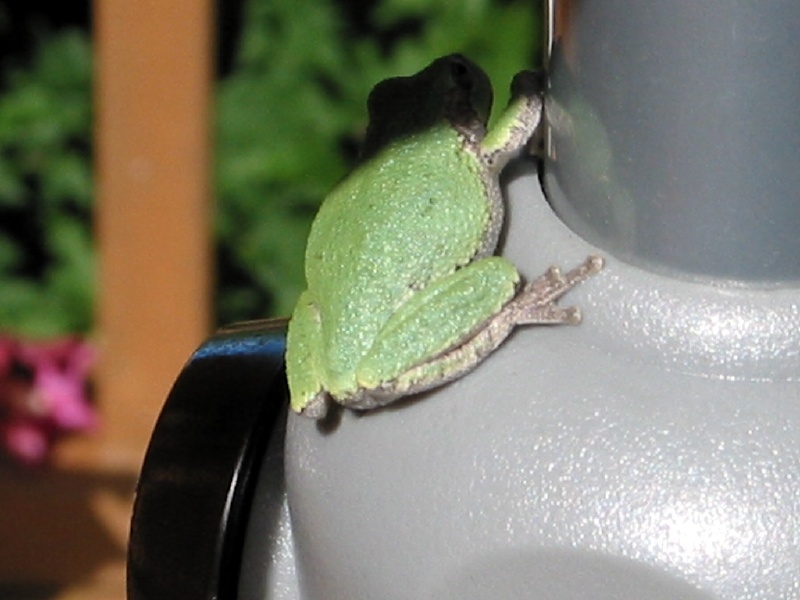
Now that I've looked through my book on North American wildlife I'm less sure that my frog in the umbrella is a Northern Cricket Frog. I think it is, but the description of the Green Treefrog worries me.

Can any frog expert or naturalist out there help me with an ID?

AND THEN THERE WAS ONE

I don’t know what happened to the frog I scared the shit out of, but it appears he has decided to relocate to another part of the property. Yesterday (Thursday) afternoon there was only one frog in the umbrella and I have to assume it was the one who didn’t jump down to the deck—a significant leap, by the way.

In fact, last night there were no frogs left that I could see, so I closed the umbrella and put the bungee cord around it. I couldn’t know if this was a permanent condition, but I was hoping one or both would come back. Cleaning a little frog shit off the tabletop seemed like a small price to pay for having them as companions.

This afternoon I took the bungee cord off and lifted up a panel of the umbrella to see what I could see, and there was one frog, looking not unhappy. It was weird, though, because he seemed to be almost all tan and had little if any green on him. I’d seen this before and it might be that they can change color a bit when they want or need to.

I didn’t want to crank the umbrella up and disturb him, but I looked around as best I could and didn’t see another frog anywhere. So maybe the other guy did decide he’d rather live somewhere a guy didn’t shine a flashlight in his eyes and scare him into making a seven foot jump into the darkness. He might have hurt himself making that leap—I can’t be sure one way or the other. I saw no evidence of him on the deck, so if he died, he didn’t die where he landed. I hope he’d okay, but I’d give odds he won’t be back in the umbrella.

I’ve done a lot of damage to my local wildlife this week. None of it was intentional, but you know the old saying about good intentions. Seems it often happens that way when humans interact with wild things. We don’t mean to do them harm, but we end up doing it in spite of ourselves.

08/18/06

LIFE & DEATH IN THE BACKYARD

You can get yourself into trouble sometimes if you believe your own hot air (politicians, take note). I had just finished writing about how mating season was mostly over for the birds, so I decided to clean out my bluebird houses.

The first one has had any number of sparrow families nest in it this year and it was filled nearly to the top with nesting material. Feathers from God only knows how many species of birds, leaves, straw, grass, pieces of plastic bags—you name it. I suspect each successive family didn’t bother to clean up what the last outfit had left, they just built on top of what was already there.

The second house was just as full of stuff, but this time there were eggs mixed in with it. Four small buff eggs with brown spots. Oops. Sorry folks, but it was time to clean house.

The last house was absolutely packed full of stuff. And it was packed in hard, so I had to really yank it to get it out. Well…when I yanked I got more than nest. Three little chicks tumbled to the ground, too.

Oh shit. Not what I wanted to have happen. My black Lab got all excited and by the time I shooed her away, two of them took off into the weeds. The last one I grabbed quickly and stuffed it and the nest back into the box as best I could.

I had a pretty good idea of where the other two had gone, but the weeds were thick and high. So I pointed the dog to where I knew bird number two had gone in and told her to find the bird. She’s not trained as a bird dog, but she has a pretty good nose and damned if she didn’t find it. I could hear it peeping as she nosed around in the weeds. But she got a little too excited and stepped on the damned thing before I could grab it, so we had little tragedy. I grabbed the dead bird and threw it into the cat o’ nine tails before the dog decided she had to eat it.

I dug around in the weeds where I had seen the third chick enter, but couldn’t find it, so I went back in the house feeling bad about the whole episode.

A couple hours later we were out picking tomatoes in the garden and I decided to try again to find the last chick. I set the dog where I thought it might be and damned if she didn’t find it right away. It took some time to dig down through the brush to find it, but I finally grabbed it and popped it into the hole in the box where I had previously deposited its nestmate.

I don’t know if they’ll live or die, but putting them back in the nest was the only real option I had. I may check on them in the next day or two, or I may just leave well enough alone. I’ve done enough damage to my birds for one week.

08/15/06

CICADA SONGS

You can tell summer is on the wane these August afternoons by what you hear—and what you don’t hear.

Gone for the most part is birdsong. Mating season has largely come and gone, so there’s no reason to be singing for a mate now. You still hear some calls and twitters, but the melodies of spring are long gone.

On most afternoons, the dominant sound is the clatter of cicadas. Their time on this Earth as adults is short to begin with and by now it’s much shorter still. But they do not go quietly. They let us loudly know of their presence before leaving the stage.


➢ Eight buzzards—yes, I know they’re correctly called vultures—are circling about a half-mile away, rising the late afternoon thermals. Must be something BIG and dead there.

➢ Big day for big butterflies today—Black Swallowtail, Tiger Swallowtail and a Monarch.


N.B. The frogs are still there, nearly six hours after I left them. One has a big turd hanging out his ass. I shined a flashlight on him and he jumped. The frog went one way and the turd went another. Guess you could say I scared the shit out of him.

08/15/06

TWO FROGS IN THE UMBRELLA

The umbrella stayed down until Sunday, when we wanted to put tung oil on the patio table and chairs to keep the wood well preserved and good looking. So after I wiped the table with mineral spirits to clean the surface, I opened the umbrella up to shade the table.

A frog fell out of the umbrella onto the table as soon as I started cranking and I figured that was the one I had seen on Friday evening. But when I got the umbrella fully open, I noticed a second frog on the metal collar that connects the struts of the umbrella and rides up and down on the pole. So now there were two frogs living in the umbrella. A regular frog family in there. Or at least there had been until I rather rudely dislodged one from his perch.

I tried to catch the little guy on the table so I could return him to his pal, but he would have none of it. The first hop was off the table onto the deck, where we repeated our little pantomime and he ended up in the bed around the deck with the Rose of Sharon bushes. Okay, fine, be that way. You found your way up into the umbrella once, so now we’ll see if you can repeat that performance.

Today (Tuesday) I wanted to put a second coat of tung oil on the table and chairs, so once more I opened the umbrella (I had to close it Monday because a line of thunderstorms was approaching). This time there were two frogs on the umbrella collar and both held on bravely as I raided them up with the umbrella.

They didn’t stay on the collar long, though. Both crawled out onto the aluminum struts of the umbrella and watched me do my work. They’re probably still there, though I am not.

It’s interesting how they made a home out of the inside of a patio umbrella. Certainly it provides good protection from predators, which must be numerous considering their size. Can’t be much food in there for them, so maybe they come out at night and hunt insects or whatever it is they eat. Whatever they do, they must know their way to and fro, because the frog I inadvertently chased into the garden is back. I can’t prove it’s him, but it must be.

08/15/06

THE FROG IN THE UMBRELLA

It’s been so hot and nasty this summer that we’ve spent almost zero time on the deck. Just too damned uncomfortable out there. So the umbrella over the table has been cranked down and buttoned up for months.

But in the last week or so the heat has moderated and we’ve had a string of bluebird days with low humidity, reasonable temps and a fresh breeze. Nice enough, in fact, to eat dinner on the deck Friday night.

Before firing up the grill to burn some burgers, I took the bungee cord off the umbrella and cranked it up to give us some additional shade. As I was finishing up the chore, I happened to look at the crank handle and there sat a tiny frog, scrunched up between the inside of the crank and the pole.

When I say tiny, I mean downright miniscule. Tiniest frog I’ve ever seen…maybe twice the size of my thumbnail. An inch long at most. He—or she or it—was light brown and green. At first I thought it was a toad, but a little poking around on the Internet showed it was a Northern Cricket Frog.

Not wanting to disturb our little lodger any more than I had already, I left the umbrella up when we were done eating. Seemed like the least I could do for our guest.

By dusk there was no sign of the frog anymore, so I cranked the umbrella back down.

08/13/06

Friday, October 21, 2005

AS WELL AS WE COULD HAVE HOPED

Xiao Li is in the final course of his chemo treatments and every test thus far has shown no recurrence of cancer. He's even gained a little weight lately, which is good news, because he's a pretty skinny guy to begin with and the chemo has made him pretty sick and eating wasn't a high priority.

Of course there are no guarantees the good news will continue, but if we had known six months ago he'd be in this shape right now, we'd have taken that bet in a hurry.

Li's problems aren't the only ones in the family. Xiao Hong's husband tried to kill himself with an overdose of sleeping pills recently. Most of us were wondering why she bothered to take him to the hospital to save his life. The guy's a loser and I don't trust him as far as I can throw him. The first time I went to China in '97 he was in jail for being involved with selling stolen cars. I just don't like the guy. This is her second loser husband. She seems to have a knack for attracting them and then marrying them. Maybe that makes her a loser, too.

Monday, August 08, 2005

STARTING DOWN THE ROAD

Xiao Li has started chemo treatments. He didn't have much reaction at first and I think he perhaps thought we had misled him about the nastiness of chemotherapy. Then he got sick as a dog and now he knows we did not exaggerate.

But he's getting through it. He's getting the treatments at a hospital in Qinhuangdao, so at least he's in his hometown and not 350 km away in Tianjin. Something to be said for that.

Once he's done with his course of treatment I want to try to get him a B-2 visa so he can come to visit. Who knows what his longterm outlook is, so let's at least give him a chance to see the USA now. He's in the queue for a green card, but the quota has been exhausted for this year and there's no telling how long that process might take. Let's not wait. It would only be a short stay, but that's okay.

Wednesday, July 27, 2005

SOME HOPEFUL NEWS

Xiao Li went back to the cancer hospital in Tianjin yesterday for a checkup. The doctors told him things look good thus far. They've decided to start his chemo treatments in September.

So things are looking up a bit for Li. I hope this positive news will make him start thinking more positively about his future. I don't think you can ever get well if you don't think good thoughts.

Thursday, July 21, 2005

LITTLE STEPS

Xiao Li took a taxi to Maia's house today by himself. Doesn't sound like much but it's a small step forward for him. He still gets tired quickly and since he's now missing part of one lung I expect that won't change.

The thing we have to do now is to get him to think good thoughts and not dwell on his disease. None of us is guaranteed any days on this Earth, so there's no reason why he should sit around thinking morbid thoughts, which is what he's been doing. Maybe he'll be dead in five years, maybe he won't. Maybe we'll all be dead in five years. Who knows? I sure don't think I'm guaranteed the next five, so just live them one day at a time and thank God every morning when you wake up and it's a new day and you're still alive. Works for me.

I haven't heard when they're going to start the chemo treatments. I would assume it would be pretty soon. We gave him a bunch of folic acid tablets, which should help his body deal with the insult from the chemo. At least that's what I've been told by other people who have had relatives go through chemo.
\

Thursday, July 07, 2005

MORE WAIT AND SEE

It's been nearly a week now since Xiao Li's surgery. They've finally gotten him out of bed. They keep you forever in Chinese hospitals, both before and after surgery. Not like here where they have you up and out ASAP.

I'm sure we sometimes send people home too soon to save money, but keeping someone in hospital for weeks after surgery when they have no complications is equally stupid. A large number of people end up getting sick in hospitals from all the germs circulating there and more than a few end up worse than when they came in the door. And trust me, Chinese hospitals have a lot to learn when it comes to cleanliness.

Still no word on the post-surgery biopsy to see if they got all the tumor. Let's pray they did. They're supposed to start him on chemo pretty soon, I think; I'll have to get the complete story on that when my wife gets home from China tonight.

But so far, so good.

Friday, July 01, 2005

CROSS YOUR FINGERS

The surgery is over and done and now all we can do is wait. If the surgeons did their job properly it's now up to Xiao Li and his will to live. I hope his will to live is strong.

The cancer is non-small cell, which is good news, if there can be any good news about lung cancer. If they got all the tumors and the cancer hasn't spread to places they haven't found, the odds of Li living at least another five years are pretty good. But what's needed now is follow-on chemo treatment and that may be a problem over there. The doctors there may not be up to snuff on the latest treatments and the drugs currently being used very successfully in the US may not be available.

All we can do is push them, but even that may not be enough. Let's hope it is.